injury prevention and first aid
Injuries are unfortunately a part of football – but they don't have to mean the end of your career! With the right measures, the risk can be drastically minimized. On this page, you'll learn not only how to effectively prevent injuries, but also important first aid tips for acute cases that will help you get back into the game quickly. We'll also show you how to achieve the best possible recovery so you can get back on the pitch fit and ready faster than ever before.
Ready to minimize your risk of injury? Sign up for a free initial consultation and learn how you can take preventative measures to stay injury-free!
Proper warm-up
Warming up properly is crucial to preventing injuries in football. Targeted exercises prepare muscles, tendons and joints for the upcoming strain, promote blood circulation and activate the nervous system. A good warm-up program should be divided into phases and last at least 15-20 minutes.
The FIFA warm-up program, known as “FIFA 11+”, is an established and scientifically proven injury prevention program. It consists of a structured sequence of exercises specifically designed to reduce the risk of injuries such as cruciate ligament tears, muscle strains or ankle injuries.

Studies show that the FIFA 11+ program can reduce the risk of serious injuries, especially in the knee area, by up to 30-50%. The exercises are gradually made more demanding to get the body used to greater stress.
Structure of the FIFA 11+ warm-up program
1. Warm-up (running, mobility)
✓ Light jogging (4-6 minutes): To activate the cardiovascular system.
✓ Variations in running: running sideways, backwards or on tiptoes to target different muscle groups.
2. Strength, balance and plyometrics
✓ Squats and lunges: Strengthen the leg muscles and stabilize the joints.
✓ One-legged stand: Improves balance and stability in the ankle and knee.
✓ Plyometric exercises: Fast, explosive movements such as jumping on one or both legs improve the reactivity of the muscles and prevent muscle strains.
3. Specific running training
✓ Fast running with changes in direction: Promotes stability and coordination by simulating sudden changes in movement that often occur in the game.
✓ Sprints with sudden stops: Train the ability to reduce speed quickly without injuring yourself.
This structured program can be used at both amateur and professional levels and should be an integral part of every training session to protect players from long-term injuries.

Static stretching after training
Static stretching after training promotes muscle relaxation and helps to increase flexibility. In contrast to dynamic stretching before training, which aims at mobility and activating the nervous system, static stretching serves to calm the body. Here, positions are held for 20-30 seconds to stretch the muscles and relieve tension. Static stretching improves mobility in the long term and reduces the risk of muscle shortening. It is particularly important after intensive sessions to loosen the muscles and support regeneration.

Proper footwear
Choosing the right football boots depends heavily on the surface. For artificial grass, shoes with shorter studs (AG soles) are suitable, as they offer more grip and control without putting excessive strain on the feet. On grass (firm ground), shoes with longer, firm studs (FG soles) should be used, which offer better grip. Soft surfaces such as wet or muddy grass require special screw-in studs (SG soles) to prevent slipping. Weather conditions also play a role: in hot weather, shoes expand slightly, while in cold weather they become stiffer and less flexible. Regularly checking the soles of the shoes for wear is important to ensure the necessary grip. You can find a huge and, above all, inexpensive selection of football boots for every surface here: Link!!! If you buy via our link, you save on shipping costs and an additional 10%.

first aid
When it comes to sports injuries, it is crucial to act quickly and correctly. A thorough first aid training can help save lives and minimize the consequences of injuries. In our opinion, every football coach should complete a first aid course and refresh it every few years in order to be prepared in an emergency. Knowledge of the right measures can be crucial for treating injuries correctly and providing professional help in a timely manner.

Points for first aid for sports injuries
1. Immediate first aid:
✓ Stay calm and assess the situation.
✓ Make sure the area is safe and there are no other hazards.
2. PECH rule: These four steps are a proven method for treating acute injuries:
✓ Pause : Stop training or playing immediately to avoid further injury.
✓ Ice : Apply ice (or a cold pack) to the affected area for 15-20 minutes. This will help reduce swelling and pain.
✓ C ompression: Lightly compress the injured area to minimize swelling. An elastic bandage can be helpful here, but the pressure should not be too strong so as not to impair blood circulation.
✓ Elevate : Elevate the affected body part as high as possible to improve blood circulation and reduce swelling.
3. First aid for specific injuries:
✓ Bruises: Apply ice to the affected area and allow rest. If pain or swelling does not subside, seek medical attention.
✓ Strains: Apply the PECH rule immediately. A medical examination may be necessary to determine the severity of the strain.
✓ Fractures: Immobilize the injured area and seek medical attention immediately. Do not attempt to fix the fracture yourself.
✓ Dislocations: Immobilize the affected area and seek medical attention immediately. Do not attempt to reset the joints yourself.
✓ Cuts and wounds: Cover the wound with a clean cloth or bandage. If there is heavy bleeding, apply pressure to the wound and seek medical attention immediately.
4. Emergency call:
✓ If the injury is more serious (e.g. unconsciousness, shortness of breath, severe pain), call emergency services immediately.
5. Documentation:
✓ Record all observations and actions so that you can pass this information on to medical personnel.
Following these steps can be critical to protecting the injured player's health and ensuring he or she receives the necessary medical treatment.

Speedy recovery
In addition to first aid, it is important to promote the best possible recovery after an injury in order to be fit and back on the pitch as quickly as possible. Here are some points that can help:
✓ Rest and relaxation: Give the injured area enough time to recover. Avoid strenuous activities until the pain has subsided.
✓ Physiotherapy: Consider physiotherapy treatment to promote mobility and perform targeted exercises to strengthen muscles.
✓ Slow return: Start with light exercise only when the pain has gone and increase the intensity gradually to avoid re-injury.

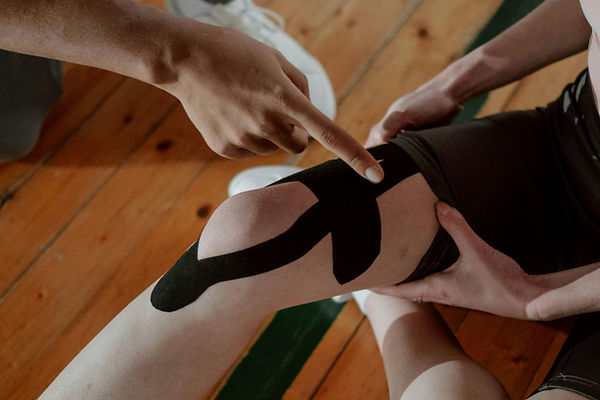
How to use Kinesio tape correctly
Knee taping:
✓ Application for: Pain in the front of the knee (e.g. patellar tendonitis)
✓ Material: 2 to 3 strips of Kinesio tape.
✓ Step-by-step:
Bend your knees slightly (approx. 30°).
Cut a long strip and stick it horizontally below the kneecap. Stick the ends on without pulling.
Glue two shorter strips diagonally across the knee from bottom to top (left and right of the kneecap).
Pull slightly in the middle and secure the ends without pulling.
Achilles tendon taping:
✓ Application for: Achilles tendon irritation or overload
✓ Material: 2 strips of Kinesio tape.
✓ Step-by-step:
Keep foot in neutral position (90° to leg).
Stick a longer strip from the ball of the foot along the Achilles tendon to the calf.
Light pull along the string, ends without pull.
Stick the second strip across the Achilles tendon at heel level.
Gentle pull to slightly relieve the strain on the tendon.
Cross/shoulder taping:
✓ Application for: Tension in the neck or upper back
✓ Material: 2 long strips, 1 shorter strip of kinesio tape.
✓ Step-by-step:
Tilt your head slightly forward.
Glue the first strip from the upper neck along the spine to the shoulder blades.
Light pull, ends without tension.
Attach the second strip parallel to the opposite side.
Attach shorter strip across the shoulders, slightly taut.
General tips:
✓ Clean skin: Make sure the skin is dry and free of oils.
✓ Moderate tension: A certain amount of tension is beneficial, but too much can reduce the effect.
✓ Cut round: Rounding corners prevents the tape from peeling off.
✓ Test for skin reaction: Try it out first to avoid skin irritation.