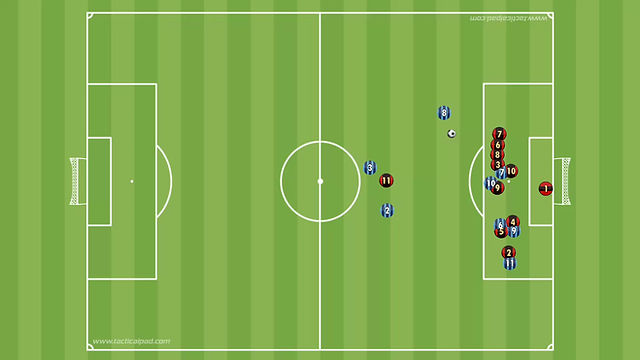
free kick
Free kicks are among the most crucial set pieces in football and can turn a game around in an instant. Statistics show that around 3-5% of all free kicks lead directly to goals – and these aren't just random strikes! While free kicks from inside the own half rarely result in goals, they can make a real difference in dangerous areas. Legends like Juninho and Lionel Messi have free kick conversion rates of over 10%, which are exceptional figures. Juninho, with 77 direct free kick goals, is considered the most successful scorer of all time! Free kicks are therefore not only a huge opportunity for the attack, but also a challenge for the defense – and therefore an essential part of any game strategy!
Want to know how to turn every free kick into a real threat? Sign up for a free initial consultation and take your free kick strategy to the next level!
technology and execution
Free kicks require precise technique that must be adapted to the situation and position. There are various ways to play the ball:
Direct free kick: Here the ball is shot directly at the goal.
✓ Spin shot: Shooter tries to circle the ball around the wall, ideal for shorter distances.
✓ Power shot (instep kick): In free kicks from a greater distance, the ball is shot at the goal with full force.
✓ Cutting under the ball: This involves giving the ball a particularly strong spin in order to either lift it or flatten it unpredictably, similar to David Beckham.

Indirect free kick: This is often used instead of a direct shot when the distance is great or the position is unfavourable. Here the ball must be touched by another player before a goal can be scored. The focus is on passing or crossing into the penalty area.
✓ Small passes to bypass the wall: Instead of shooting directly, a short pass to a teammate can surprise the defense and open up new shooting options.
Distance and angle: The distance from the goal and the angle determine the shooting technique. A free kick from 20 meters is shot differently than one from 30 meters, and shots from a central or lateral position are also different.

Tactics and moves for free kicks
Direct shot on goal: Often the preferred option when the free kick is close to the penalty area. The shooter will either try to shoot over the wall or find a gap.
✓ Over the wall: When taking free kicks near the penalty area, the taker often tries to lift the ball over the wall. Timing and the height of the wall are crucial.
Cross free kick: Especially with free kicks from the side or medium distances, the ball is crossed high into the penalty area. This gives the attackers the opportunity to head the ball directly at the goal or from the second row.
✓ Target play on the first or second post: The ball is often crossed to the first post to enable a quick header. Alternatively, the ball is hit to the second post, where an attacker waits for the rebound.
✓ Rehearsed running routes: Attackers often practice special running routes to unbalance defenders and exploit gaps in the defense.
Short free kick: Instead of hitting the ball directly at goal or crossing, the free kick is played short to speed up the game and surprise the defenders.
✓ Fast passing partner: A short pass to a free-standing player can open up new angles or leave the opposing wall running into empty space.
Trick plays: Some teams practice specially rehearsed free kick variations in which the ball is passed back and forth several times to confuse the defense and create new spaces.
✓ Fake shots: Here a player pretends to shoot the ball but lets it pass for a teammate.

Defensive free kick game
Wall position: The wall is the most important part of the defense during free kicks. The players stand 9.15 meters away from the ball and are supposed to block the shot. Depending on the distance, a wall is formed by 4-6 players.
✓ Jump to block: Players in the wall often jump to block the ball, especially when the shooter tries to flick the ball over the wall.
✓ Avoid gaps in the wall: Players in the wall must stand close together to avoid gaps through which the ball could be shot.
✓ Protecting the wall: Recently it has become common to place a player behind the wall. This position prevents the ball from being shot flat under the wall when the wall bounces up.
Goalkeeper positioning: The goalkeeper positions the wall to cover part of the goal. He focuses on the side of the goal that is not protected by the wall. Good positioning and quick reaction are crucial to save the ball.
✓ Early anticipation: Some goalkeepers try to read the behavior of the shooter and focus on a corner early.
Defending cross free kicks: During cross free kicks, defenders move back into the penalty area to mark opposing players and win aerial duels.
✓ Zonal defense: The defenders are responsible for specific areas in the penalty area and try to clear the ball in their zone.
✓ Man-to-man marking: Alternatively, man-to-man marking can be chosen, where each defender keeps an eye on a specific opponent.
Blocking trick plays: During indirect or tricky free kicks, defenders must be particularly alert to prevent quick passes and unexpected runs.
.png)
Exercises for passing with ball reception and ball control
The exercises are mostly arranged according to difficulty to allow for a gradual increase in demands.
In addition, many of these exercises can easily be performed with more players by forming additional groups.
As a coach, there are of course no limits to what you can do – you can vary, combine or adapt the exercises to suit the needs of your players and training goals.
1. Simple ball reception
✓ Goal: Control the ball after a flat pass.
✓ Setup: Two players face each other in a 10x10 meter field.
✓ Number of players: 2 players
✓ Procedure: Player A plays a flat pass to player B. Player B stops the ball with the inside of his foot and passes it back with the other foot after two contacts.
✓ Coaching tips:
Secure your ankle to stop the ball precisely.
Tilt your upper body slightly forward to maintain balance.
✓ Variations:
Limit ball contacts to a maximum of one.
Play the pass harder to increase the difficulty.

2. Ball reception with change of direction
✓ Goal: To control the ball and change direction at the same time.
✓ Setup: Two players, 10x10 meter field.
✓ Number of players: 2 players
✓ Procedure: Player A passes the ball to Player B, who receives the ball with the inside of his foot and takes it in a new direction. Player B then makes a 90° turn to the left or right and returns the ball.
✓ Coaching tips:
Use the first contact to steer the ball in the new direction.
Look up in front of the reception to scan the room.
✓ Variations:
Add cones as opponents to simulate more pressure.
Reduce the time for changing direction to a maximum of two seconds.