


Passing with ball reception and ball carrying
The first touch of the ball decides everything! A perfect control gives you time, space, and control – a bad one immediately puts you under pressure. Anyone who wants to play at the highest level needs to control the ball cleanly, pass precisely, and move at lightning speed. The right timing, the perfect body angle, and an eye for the next move make the difference between a good player and an outstanding one.
Do you want to take your technique to the next level and stay in control in every situation? Then register now for a free initial consultation and secure the decisive advantage on the court!
Exercises for passing with ball reception and ball control
The exercises are mostly arranged according to difficulty to allow for a gradual increase in demands.
In addition, many of these exercises can easily be performed with more players by forming additional groups.
As a coach, there are of course no limits to what you can do – you can vary, combine or adapt the exercises to suit the needs of your players and training goals.
1. Simple ball reception
✓ Goal: Control the ball after a flat pass.
✓ Setup: Two players face each other in a 10x10 meter field.
✓ Number of players: 2 players
✓ Procedure: Player A plays a flat pass to player B. Player B stops the ball with the inside of his foot and passes it back with the other foot after two contacts.
✓ Coaching tips:
Secure your ankle to stop the ball precisely.
Tilt your upper body slightly forward to maintain balance.
✓ Variations:
Limit ball contacts to a maximum of one.
Play the pass harder to increase the difficulty.

2. Ball reception with change of direction
✓ Goal: To control the ball and change direction at the same time.
✓ Setup: Two players, 10x10 meter field.
✓ Number of players: 2 players
✓ Procedure: Player A passes the ball to Player B, who receives the ball with the inside of his foot and takes it in a new direction. Player B then makes a 90° turn to the left or right and returns the ball.
✓ Coaching tips:
Use the first contact to steer the ball in the new direction.
Look up in front of the reception to scan the room.
✓ Variations:
Add cones as opponents to simulate more pressure.
Reduce the time for changing direction to a maximum of two seconds.

3. Receiving the ball with the chest
✓ Goal: Safely control high balls.
✓ Setup: One player passes, the other stands ready to receive the ball. Playing area: 10x10 meters.
✓ Number of players: 2 players
✓ Procedure: Player A throws the ball up, Player B receives it with his chest and brings it to the ground in a controlled manner before returning it.
✓ Coaching tips:
-
Arch your chest slightly upwards to cushion the ball.
-
Lower your body quickly after contact to maintain control.
✓ Variations:
-
Throw the ball from different heights.
-
Add a bounce before receiving the ball.

4. Ball carrying while running
✓ Goal: Control the ball at full speed.
✓ Setup: 20x10 meter field, one player passes, the other runs in.
✓ Number of players: 2 players
✓ Procedure: Player B runs at high speed towards a passed ball, takes it with the first contact in the direction of travel and passes it on after two contacts.
✓ Coaching tips:
Timing is crucial – the ball should arrive at the perfect moment.
Use the outside of your foot or the inside of your foot to control the ball precisely.
✓ Variations:
Add a defender to put pressure from behind.
Reduce the size of the playing field to simulate tight spaces.

4. Ball carrying while running
✓ Goal: Control the ball at full speed.
✓ Setup: 20x10 meter field, one player passes, the other runs in.
✓ Number of players: 2 players
✓ Procedure: Player B runs at high speed towards a passed ball, takes it with the first contact in the direction of travel and passes it on after two contacts.
✓ Coaching tips:
Timing is crucial – the ball should arrive at the perfect moment.
Use the outside of your foot or the inside of your foot to control the ball precisely.
✓ Variations:
Add a defender to put pressure from behind.
Reduce the size of the playing field to simulate tight spaces.

4. Ball carrying while running
✓ Goal: Control the ball at full speed.
✓ Setup: 20x10 meter field, one player passes, the other runs in.
✓ Number of players: 2 players
✓ Procedure: Player B runs at high speed towards a passed ball, takes it with the first contact in the direction of travel and passes it on after two contacts.
✓ Coaching tips:
Timing is crucial – the ball should arrive at the perfect moment.
Use the outside of your foot or the inside of your foot to control the ball precisely.
✓ Variations:
Add a defender to put pressure from behind.
Reduce the size of the playing field to simulate tight spaces.

4. Ball carrying while running
✓ Goal: Control the ball at full speed.
✓ Setup: 20x10 meter field, one player passes, the other runs in.
✓ Number of players: 2 players
✓ Procedure: Player B runs at high speed towards a passed ball, takes it with the first contact in the direction of travel and passes it on after two contacts.
✓ Coaching tips:
Timing is crucial – the ball should arrive at the perfect moment.
Use the outside of your foot or the inside of your foot to control the ball precisely.
✓ Variations:
Add a defender to put pressure from behind.
Reduce the size of the playing field to simulate tight spaces.
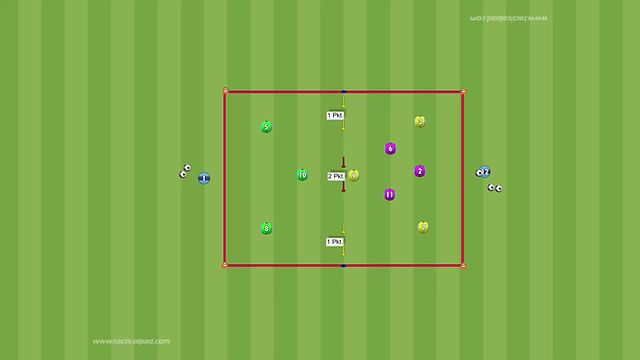
4. Ball carrying while running
✓ Goal: Control the ball at full speed.
✓ Setup: 20x10 meter field, one player passes, the other runs in.
✓ Number of players: 2 players
✓ Procedure: Player B runs at high speed towards a passed ball, takes it with the first contact in the direction of travel and passes it on after two contacts.
✓ Coaching tips:
Timing is crucial – the ball should arrive at the perfect moment.
Use the outside of your foot or the inside of your foot to control the ball precisely.
✓ Variations:
Add a defender to put pressure from behind.
Reduce the size of the playing field to simulate tight spaces.

20. Passing circle with clapping pass wave & active center
✓ Goal: Improve passing rhythm, teamwork under time pressure and speed of action with decision-making in the center.
✓ Structure:
8–12 players form a large circle (diameter approx. 20–25 meters)
2 balls start at the same time at opposite points
2 players are in the middle of the circle
Each outside player knows his position (A, B, C, D, ...)
Coach stands outside and gives situational commands
✓ Process:
Player A passes diagonally to C (skips B)
C claps to B, who immediately passes to D
D claps on C, who continues playing to E, etc.
The two central players move in parallel in the inner circle:
They specifically look for gaps, cross paths, and actively offer themselves
They constantly change their positions (e.g., swinging, diagonal, ready to dribble)
Coach command (e.g. “Center!”):
The winger who currently has the ball plays it flat into the path of a midfielder
The central player takes the ball cleanly, plays a one-two or passes to the next winger
After that, the pass wave continues to run normally
✓ Variations:
If it is too challenging, first do the exercise with 1 ball
Limit contacts (gossip = 1 contact, rest max. 2)
Only one central player who offers himself alone → higher pressure
After successful center contact: Return the ball in the opposite rhythm
Coach gives color or name → targeted pass to center (e.g. “Red!”)
✓ Coaching tips:
Central players: Always on the move, good body language, looking for a “free shoulder”
Wing player: Clear commands (“clap!”, “turn up!”, “forward!”), open position, quick thinking
Timing of clapping passes is crucial for the flow of the game
Make sure the two balls are played at the same time – no break in the circle!
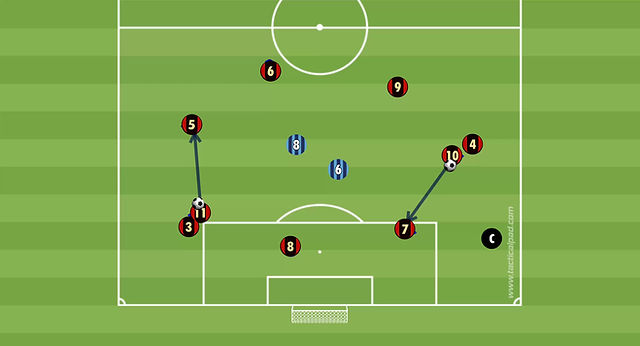
21. Tactical "4 against 4" with superior numbers
✓ Goal: Tactical decisions and passing under pressure.
✓ Setup: A field (approximately 30 x 30 meters) is marked out. Two teams of four players each and, if possible, two additional neutral players.
✓ Number of players: At least 8 players
✓ Process:
Two teams of four players each play against each other in the marked field.
Additionally, there are two neutral players on the field who always interact with the team in possession (e.g., by wearing neutral-colored jerseys). This creates a 6-on-4 advantage for the team in possession.
The aim is to have as long a period of possession as possible through clever combination play
The neutral players may move freely throughout the field
✓ Variation: Change the majority rule by adding more or fewer neutral players.
✓ Coaching tips:
Force quick decisions under pressure (“one touch”, “max. 2 contacts” possible as a rule).
Promote communication, e.g., through clear announcements (“time,” “middle free”).
Motivate players to constantly move without the ball in order to remain available for play.
Sharpen your awareness of situations where the ball is outnumbered – who is free? Who can shift the ball?

22. Ball carrying in the "cage"
✓ Goal: Ball control and passing under pressure.
✓ Setup: Playing field: 15 x 15 meters with a central area (“cage”) of approximately 5 x 5 m marked in the middle.
✓ Number of players: At least 8 players: 4 in the center, 4 distributed outside
✓ Process:
The central players pass the ball to each other (max. 2 contacts) and look for a clean pass to a wide player.
The outside player immediately plays a new ball back into the cage.
There is constant movement: after each pass, a wing player rotates with the passer in the cage – so everyone is always active.
Optional: 1 defender in the middle creates light pressure, but is not allowed to slide tackle.
✓ Variations:
Two balls in play at the same time.
Contact limitation (e.g. 1 contact inside, 2 outside).
2 defenders in the middle (possession play in the center becomes more difficult).
✓ Coaching tips:
Carrying the ball with an open body – looking towards the next passing station.
Actively look for playing positions – always keep moving in the cage.
Promote quick decision-making (“Do you pass back, shift, or turn up the pace?”).
Communication loudly and clearly (“Turn it up!”, “Come in a minute!”).

23. Combination game in the "fishing net"
✓ Goal: Promote passing precision and the recognition of gaps in the opponent's formation.
✓ Setup: Two groups of three face each other on opposite sides of a rectangular field (approximately 20 x 30 meters). A line of four players forms the center line, acting as a "net."
✓ Number of players: At least 10 players (6 outside, 4 in the net); 12 possible (8 outside, 4 in the net)
✓ Process:
The three players on one side pass the ball freely to each other with the aim of identifying a gap in the chain.
As soon as a suitable gap opens up, a flat pass should be played to the other side through the “net”.
The defenders in the net try to intercept the ball without crossing the sideline.
If the pass goes through the net, the game starts again on the other side.
After a certain time or number of successful breakthroughs, a substitution is made – for example, the player who made the bad pass goes into the net.
✓ Variations:
Adjust field size (narrower = more difficult)
Contact limitation for outside players
Dribbling ban or obligation to play directly
Game with two balls for very advanced groups
Change the network to three or five players
✓ Coaching tips:
Good positioning of the outside players to get the chain moving
Use body openings and pass feints
Right moment for the interface pass = train timing
Switching behavior in the network: Re-sort immediately after passing attempt
Pass must be flat and sharp

1. Simple ball reception
✓ Goal: Control the ball after a flat pass.
✓ Setup: Two players face each other in a 10x10 meter field.
✓ Number of players: 2 players
✓ Procedure: Player A plays a flat pass to player B. Player B stops the ball with the inside of his foot and passes it back with the other foot after two contacts.
✓ Coaching tips:
Secure your ankle to stop the ball precisely.
Tilt your upper body slightly forward to maintain balance.
✓ Variations:
Limit ball contacts to a maximum of one.
Play the pass harder to increase the difficulty.

2. Ball reception with change of direction
✓ Goal: To control the ball and change direction at the same time.
✓ Setup: Two players, 10x10 meter field.
✓ Number of players: 2 players
✓ Procedure: Player A passes the ball to Player B, who receives the ball with the inside of his foot and takes it in a new direction. Player B then makes a 90° turn to the left or right and returns the ball.
✓ Coaching tips:
Use the first contact to steer the ball in the new direction.
Look up in front of the reception to scan the room.
✓ Variations:
Add cones as opponents to simulate more pressure.
Reduce the time for changing direction to a maximum of two seconds.

3. Receiving the ball with the chest
✓ Goal: Safely control high balls.
✓ Setup: One player passes, the other stands ready to receive the ball. Playing area: 10x10 meters.
✓ Number of players: 2 players
✓ Procedure: Player A throws the ball up, Player B receives it with his chest and brings it to the ground in a controlled manner before returning it.
✓ Coaching tips:
-
Arch your chest slightly upwards to cushion the ball.
-
Lower your body quickly after contact to maintain control.
✓ Variations:
-
Throw the ball from different heights.
-
Add a bounce before receiving the ball.

4. Ball carrying while running
✓ Goal: Control the ball at full speed.
✓ Setup: 20x10 meter field, one player passes, the other runs in.
✓ Number of players: 2 players
✓ Procedure: Player B runs at high speed towards a passed ball, takes it with the first contact in the direction of travel and passes it on after two contacts.
✓ Coaching tips:
Timing is crucial – the ball should arrive at the perfect moment.
Use the outside of your foot or the inside of your foot to control the ball precisely.
✓ Variations:
Add a defender to put pressure from behind.
Reduce the size of the playing field to simulate tight spaces.

4. Ball carrying while running
✓ Goal: Control the ball at full speed.
✓ Setup: 20x10 meter field, one player passes, the other runs in.
✓ Number of players: 2 players
✓ Procedure: Player B runs at high speed towards a passed ball, takes it with the first contact in the direction of travel and passes it on after two contacts.
✓ Coaching tips:
Timing is crucial – the ball should arrive at the perfect moment.
Use the outside of your foot or the inside of your foot to control the ball precisely.
✓ Variations:
Add a defender to put pressure from behind.
Reduce the size of the playing field to simulate tight spaces.

4. Ball carrying while running
✓ Goal: Control the ball at full speed.
✓ Setup: 20x10 meter field, one player passes, the other runs in.
✓ Number of players: 2 players
✓ Procedure: Player B runs at high speed towards a passed ball, takes it with the first contact in the direction of travel and passes it on after two contacts.
✓ Coaching tips:
Timing is crucial – the ball should arrive at the perfect moment.
Use the outside of your foot or the inside of your foot to control the ball precisely.
✓ Variations:
Add a defender to put pressure from behind.
Reduce the size of the playing field to simulate tight spaces.

4. Ball carrying while running
✓ Goal: Control the ball at full speed.
✓ Setup: 20x10 meter field, one player passes, the other runs in.
✓ Number of players: 2 players
✓ Procedure: Player B runs at high speed towards a passed ball, takes it with the first contact in the direction of travel and passes it on after two contacts.
✓ Coaching tips:
Timing is crucial – the ball should arrive at the perfect moment.
Use the outside of your foot or the inside of your foot to control the ball precisely.
✓ Variations:
Add a defender to put pressure from behind.
Reduce the size of the playing field to simulate tight spaces.

4. Ball carrying while running
✓ Goal: Control the ball at full speed.
✓ Setup: 20x10 meter field, one player passes, the other runs in.
✓ Number of players: 2 players
✓ Procedure: Player B runs at high speed towards a passed ball, takes it with the first contact in the direction of travel and passes it on after two contacts.
✓ Coaching tips:
Timing is crucial – the ball should arrive at the perfect moment.
Use the outside of your foot or the inside of your foot to control the ball precisely.
✓ Variations:
Add a defender to put pressure from behind.
Reduce the size of the playing field to simulate tight spaces.

20. Passing circle with clapping pass wave & active center
✓ Goal: Improve passing rhythm, teamwork under time pressure and speed of action with decision-making in the center.
✓ Structure:
8–12 players form a large circle (diameter approx. 20–25 meters)
2 balls start at the same time at opposite points
2 players are in the middle of the circle
Each outside player knows his position (A, B, C, D, ...)
Coach stands outside and gives situational commands
✓ Process:
Player A passes diagonally to C (skips B)
C claps to B, who immediately passes to D
D claps on C, who continues playing to E, etc.
The two central players move in parallel in the inner circle:
They specifically look for gaps, cross paths, and actively offer themselves
They constantly change their positions (e.g., swinging, diagonal, ready to dribble)
Coach command (e.g. “Center!”):
The winger who currently has the ball plays it flat into the path of a midfielder
The central player takes the ball cleanly, plays a one-two or passes to the next winger
After that, the pass wave continues to run normally
✓ Variations:
If it is too challenging, first do the exercise with 1 ball
Limit contacts (gossip = 1 contact, rest max. 2)
Only one central player who offers himself alone → higher pressure
After successful center contact: Return the ball in the opposite rhythm
Coach gives color or name → targeted pass to center (e.g. “Red!”)
✓ Coaching tips:
Central players: Always on the move, good body language, looking for a “free shoulder”
Wing player: Clear commands (“clap!”, “turn up!”, “forward!”), open position, quick thinking
Timing of clapping passes is crucial for the flow of the game
Make sure the two balls are played at the same time – no break in the circle!

21. Tactical "4 against 4" with superior numbers
✓ Goal: Tactical decisions and passing under pressure.
✓ Setup: A field (approximately 30 x 30 meters) is marked out. Two teams of four players each and, if possible, two additional neutral players.
✓ Number of players: At least 8 players
✓ Process:
Two teams of four players each play against each other in the marked field.
Additionally, there are two neutral players on the field who always interact with the team in possession (e.g., by wearing neutral-colored jerseys). This creates a 6-on-4 advantage for the team in possession.
The aim is to have as long a period of possession as possible through clever combination play
The neutral players may move freely throughout the field
✓ Variation: Change the majority rule by adding more or fewer neutral players.
✓ Coaching tips:
Force quick decisions under pressure (“one touch”, “max. 2 contacts” possible as a rule).
Promote communication, e.g., through clear announcements (“time,” “middle free”).
Motivate players to constantly move without the ball in order to remain available for play.
Sharpen your awareness of situations where the ball is outnumbered – who is free? Who can shift the ball?

22. Ball carrying in the "cage"
✓ Goal: Ball control and passing under pressure.
✓ Setup: Playing field: 15 x 15 meters with a central area (“cage”) of approximately 5 x 5 m marked in the middle.
✓ Number of players: At least 8 players: 4 in the center, 4 distributed outside
✓ Process:
The central players pass the ball to each other (max. 2 contacts) and look for a clean pass to a wide player.
The outside player immediately plays a new ball back into the cage.
There is constant movement: after each pass, a wing player rotates with the passer in the cage – so everyone is always active.
Optional: 1 defender in the middle creates light pressure, but is not allowed to slide tackle.
✓ Variations:
Two balls in play at the same time.
Contact limitation (e.g. 1 contact inside, 2 outside).
2 defenders in the middle (possession play in the center becomes more difficult).
✓ Coaching tips:
Carrying the ball with an open body – looking towards the next passing station.
Actively look for playing positions – always keep moving in the cage.
Promote quick decision-making (“Do you pass back, shift, or turn up the pace?”).
Communication loudly and clearly (“Turn it up!”, “Come in a minute!”).

23. Combination game in the "fishing net"
✓ Goal: Promote passing precision and the recognition of gaps in the opponent's formation.
✓ Setup: Two groups of three face each other on opposite sides of a rectangular field (approximately 20 x 30 meters). A line of four players forms the center line, acting as a "net."
✓ Number of players: At least 10 players (6 outside, 4 in the net); 12 possible (8 outside, 4 in the net)
✓ Process:
The three players on one side pass the ball freely to each other with the aim of identifying a gap in the chain.
As soon as a suitable gap opens up, a flat pass should be played to the other side through the “net”.
The defenders in the net try to intercept the ball without crossing the sideline.
If the pass goes through the net, the game starts again on the other side.
After a certain time or number of successful breakthroughs, a substitution is made – for example, the player who made the bad pass goes into the net.
✓ Variations:
Adjust field size (narrower = more difficult)
Contact limitation for outside players
Dribbling ban or obligation to play directly
Game with two balls for very advanced groups
Change the network to three or five players
✓ Coaching tips:
Good positioning of the outside players to get the chain moving
Use body openings and pass feints
Right moment for the interface pass = train timing
Switching behavior in the network: Re-sort immediately after passing attempt
Pass must be flat and sharp

1. Simple ball reception
✓ Goal: Control the ball after a flat pass.
✓ Setup: Two players face each other in a 10x10 meter field.
✓ Number of players: 2 players
✓ Procedure: Player A plays a flat pass to player B. Player B stops the ball with the inside of his foot and passes it back with the other foot after two contacts.
✓ Coaching tips:
Secure your ankle to stop the ball precisely.
Tilt your upper body slightly forward to maintain balance.
✓ Variations:
Limit ball contacts to a maximum of one.
Play the pass harder to increase the difficulty.

2. Ball reception with change of direction
✓ Goal: To control the ball and change direction at the same time.
✓ Setup: Two players, 10x10 meter field.
✓ Number of players: 2 players
✓ Procedure: Player A passes the ball to Player B, who receives the ball with the inside of his foot and takes it in a new direction. Player B then makes a 90° turn to the left or right and returns the ball.
✓ Coaching tips:
Use the first contact to steer the ball in the new direction.
Look up in front of the reception to scan the room.
✓ Variations:
Add cones as opponents to simulate more pressure.
Reduce the time for changing direction to a maximum of two seconds.

3. Receiving the ball with the chest
✓ Goal: Safely control high balls.
✓ Setup: One player passes, the other stands ready to receive the ball. Playing area: 10x10 meters.
✓ Number of players: 2 players
✓ Procedure: Player A throws the ball up, Player B receives it with his chest and brings it to the ground in a controlled manner before returning it.
✓ Coaching tips:
-
Arch your chest slightly upwards to cushion the ball.
-
Lower your body quickly after contact to maintain control.
✓ Variations:
-
Throw the ball from different heights.
-
Add a bounce before receiving the ball.

4. Ball carrying while running
✓ Goal: Control the ball at full speed.
✓ Setup: 20x10 meter field, one player passes, the other runs in.
✓ Number of players: 2 players
✓ Procedure: Player B runs at high speed towards a passed ball, takes it with the first contact in the direction of travel and passes it on after two contacts.
✓ Coaching tips:
Timing is crucial – the ball should arrive at the perfect moment.
Use the outside of your foot or the inside of your foot to control the ball precisely.
✓ Variations:
Add a defender to put pressure from behind.
Reduce the size of the playing field to simulate tight spaces.

4. Ball carrying while running
✓ Goal: Control the ball at full speed.
✓ Setup: 20x10 meter field, one player passes, the other runs in.
✓ Number of players: 2 players
✓ Procedure: Player B runs at high speed towards a passed ball, takes it with the first contact in the direction of travel and passes it on after two contacts.
✓ Coaching tips:
Timing is crucial – the ball should arrive at the perfect moment.
Use the outside of your foot or the inside of your foot to control the ball precisely.
✓ Variations:
Add a defender to put pressure from behind.
Reduce the size of the playing field to simulate tight spaces.

4. Ball carrying while running
✓ Goal: Control the ball at full speed.
✓ Setup: 20x10 meter field, one player passes, the other runs in.
✓ Number of players: 2 players
✓ Procedure: Player B runs at high speed towards a passed ball, takes it with the first contact in the direction of travel and passes it on after two contacts.
✓ Coaching tips:
Timing is crucial – the ball should arrive at the perfect moment.
Use the outside of your foot or the inside of your foot to control the ball precisely.
✓ Variations:
Add a defender to put pressure from behind.
Reduce the size of the playing field to simulate tight spaces.

4. Ball carrying while running
✓ Goal: Control the ball at full speed.
✓ Setup: 20x10 meter field, one player passes, the other runs in.
✓ Number of players: 2 players
✓ Procedure: Player B runs at high speed towards a passed ball, takes it with the first contact in the direction of travel and passes it on after two contacts.
✓ Coaching tips:
Timing is crucial – the ball should arrive at the perfect moment.
Use the outside of your foot or the inside of your foot to control the ball precisely.
✓ Variations:
Add a defender to put pressure from behind.
Reduce the size of the playing field to simulate tight spaces.

4. Ball carrying while running
✓ Goal: Control the ball at full speed.
✓ Setup: 20x10 meter field, one player passes, the other runs in.
✓ Number of players: 2 players
✓ Procedure: Player B runs at high speed towards a passed ball, takes it with the first contact in the direction of travel and passes it on after two contacts.
✓ Coaching tips:
Timing is crucial – the ball should arrive at the perfect moment.
Use the outside of your foot or the inside of your foot to control the ball precisely.
✓ Variations:
Add a defender to put pressure from behind.
Reduce the size of the playing field to simulate tight spaces.

4. Ball carrying while running
✓ Goal: Control the ball at full speed.
✓ Setup: 20x10 meter field, one player passes, the other runs in.
✓ Number of players: 2 players
✓ Procedure: Player B runs at high speed towards a passed ball, takes it with the first contact in the direction of travel and passes it on after two contacts.
✓ Coaching tips:
Timing is crucial – the ball should arrive at the perfect moment.
Use the outside of your foot or the inside of your foot to control the ball precisely.
✓ Variations:
Add a defender to put pressure from behind.
Reduce the size of the playing field to simulate tight spaces.

1. Simple ball reception
✓ Goal: Control the ball after a flat pass.
✓ Setup: Two players face each other in a 10x10 meter field.
✓ Number of players: 2 players
✓ Procedure: Player A plays a flat pass to player B. Player B stops the ball with the inside of his foot and passes it back with the other foot after two contacts.
✓ Coaching tips:
Secure your ankle to stop the ball precisely.
Tilt your upper body slightly forward to maintain balance.
✓ Variations:
Limit ball contacts to a maximum of one.
Play the pass harder to increase the difficulty.

2. Ball reception with change of direction
✓ Goal: To control the ball and change direction at the same time.
✓ Setup: Two players, 10x10 meter field.
✓ Number of players: 2 players
✓ Procedure: Player A passes the ball to Player B, who receives the ball with the inside of his foot and takes it in a new direction. Player B then makes a 90° turn to the left or right and returns the ball.
✓ Coaching tips:
Use the first contact to steer the ball in the new direction.
Look up in front of the reception to scan the room.
✓ Variations:
Add cones as opponents to simulate more pressure.
Reduce the time for changing direction to a maximum of two seconds.

3. Receiving the ball with the chest
✓ Goal: Safely control high balls.
✓ Setup: One player passes, the other stands ready to receive the ball. Playing area: 10x10 meters.
✓ Number of players: 2 players
✓ Procedure: Player A throws the ball up, Player B receives it with his chest and brings it to the ground in a controlled manner before returning it.
✓ Coaching tips:
-
Arch your chest slightly upwards to cushion the ball.
-
Lower your body quickly after contact to maintain control.
✓ Variations:
-
Throw the ball from different heights.
-
Add a bounce before receiving the ball.

The first touch of the ball decides everything! A perfect control gives you time, space, and control – a bad one immediately puts you under pressure. Anyone who wants to play at the highest level needs to control the ball cleanly, pass precisely, and move at lightning speed. The right timing, the perfect body angle, and an eye for the next move make the difference between a good player and an outstanding one.
Do you want to take your technique to the next level and stay in control in every situation? Then register now for a free initial consultation and secure the decisive advantage on the court!